

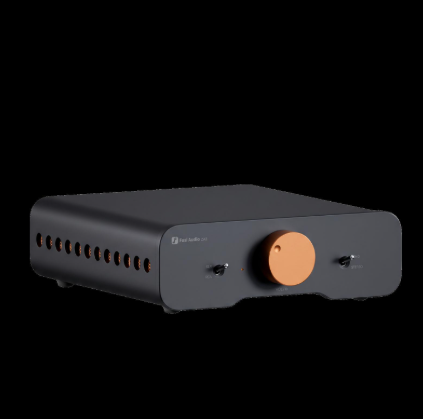
Walk into a hi-fi shop with money for music and you will be steered toward two very different boxes. One is a surround receiver — seven or nine channels, video switching, room-correction software, a remote like a TV controller. The other does two channels and almost nothing else. For film fans the choice makes itself. For music-first listeners it deserves a proper argument, because the boxes spend the same budget in opposite directions.
The receiver spreads its cost across channels, licences, video boards, and features. A 2 channel amplifier spends nearly all of it on two channels: power supply, output stage, and the analogue circuitry music passes through. Neither is ‘better’ in the abstract — but for a given price, one of them is buying an awful lot of things a music listener never switches on.
What an AV Receiver Gives You
Credit where due: receivers are astonishingly capable. Surround decoding for films, HDMI switching for every source in the house, automatic room calibration, streaming services built in, a subwoofer output with proper bass management. If your system must do films, games, and music through five or seven speakers, nothing else consolidates it all into one box. As a piece of engineering value, the modern receiver is genuinely hard to beat.
The costs are hidden rather than absent. Setup is a project. Menus bury the settings that matter. And the analogue stereo path — the one your records and high-quality streams travel — is one feature among fifty, built to a price that reflects that. Power ratings, too, are usually quoted two channels driven; ask all seven to work hard at once and the shared power supply divides its strength accordingly.
What You Give Up for Music
Play the same recording through both and the differences are not subtle at equal money. The dedicated stereo unit typically offers a quieter background, firmer bass control, and a stereo image that holds together at low volume — the level music lovers actually listen at in the evening. Its power is quoted honestly, both channels, all the time, because there is nothing else for the supply to feed. A 2 channel amplifier is a specialist, and music is the speciality: no video circuitry humming alongside the signal path, no unused channels idling in the same chassis.
There is also a longevity argument. Video standards churn every few years — today’s HDMI revision is tomorrow’s limitation — while a stereo amplifier has no standard to go obsolete. Receivers age by their sockets; stereo amps age by their capacitors, which is to say, slowly.
The Case for Keeping It Simple
Simplicity compounds. A stereo setup is two speakers to place well instead of seven to place approximately, one volume knob instead of a menu tree, and a system every member of the household can operate without instruction. Most ‘music systems’ in real homes are used for music ninety percent of the time and films through the TV’s own speakers or a soundbar the rest. Building the main system around the ninety percent is not purism; it is arithmetic.
When the Receiver Is Still the Right Call
- Films and games are half or more of your listening, and surround is non-negotiable.
- You need a subwoofer with managed bass, or room correction for a genuinely difficult space.
- One remote and one box must run the entire living room for the whole family.
A Hybrid Worth Knowing About
There is a middle path for households that want both: many stereo amplifiers now include a home-theatre bypass input, letting a receiver’s front channels pass through the stereo amp for films while music sources plug straight into the stereo unit. Each box does what it is good at — the receiver decodes and switches, the stereo amplifier drives the main speakers with its full attention. It costs more than either alone, but it ends the argument in mixed-use rooms. Ask for ‘HT bypass’ or ‘unity gain input’ when you shop — it goes by both names.
Even without the hybrid, the two systems coexist peacefully in many homes: receiver and soundbar territory in the TV corner, a 2 channel amplifier and two good speakers where the records live. Choosing per room and per purpose beats forcing one box to be adequate at everything and excellent at nothing.
If none of those describe you, the verdict follows from where the money goes. For music, a 2 channel amplifier buys better stereo for the same spend, sets up in an afternoon, and will still be current in fifteen years. The receiver is the right tool for a cinema that plays music. The stereo amp is the right tool for music that occasionally meets a film — and most of us, honestly, own the second kind of system.